Research brief

Smart CBT: a more structured layer for digital CBT

Smart CBT is Umbrella Journal’s internal framework for turning journal entries, check-ins, and repeated thinking patterns into more specific CBT guidance. The goal is not to automate clinical judgment. The goal is to make digital support more explainable, more adaptive, and less generic.

Instead of serving the same prompt to everyone, Smart CBT tries to identify the kind of distortion, loop, or avoidance pattern present in the moment, then respond with a transparent rationale, a bounded next step, and stronger safety controls around sensitive cases.
Why this work matters

Digital CBT can be effective, but it often breaks down when prompts feel generic, overly scripted, or poorly matched to the user’s actual thought pattern. Smart CBT is meant to close that gap by connecting the content of an entry to a narrower, more defensible response pattern.

Smart CBT illustration

Executive summary

Three product principles define the current Smart CBT direction.

Specificity over generic encouragement

Responses should identify the likely pattern in the entry and show why a given CBT move fits.

Explainability over opaque advice

Suggestions should make the technique legible, not feel like unexplained persuasion.

Safety routing over false confidence

Sensitive moments should trigger bounded handling, escalation options, and narrower response pathways.

Core operating model

Smart CBT is organized around four linked layers rather than one undifferentiated chat response.

1. Detection

Pattern sensing

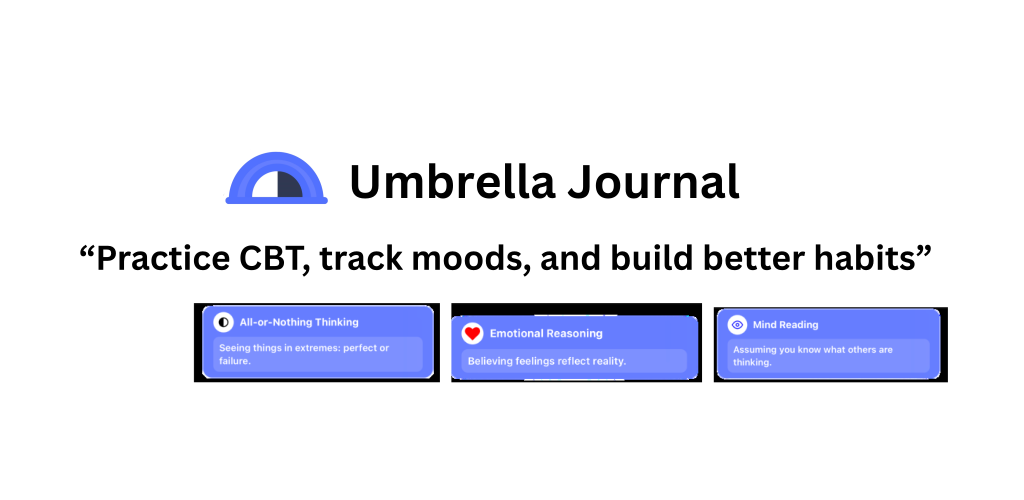
Entries are evaluated for common distortions such as catastrophizing, mind-reading, all-or-nothing thinking, and avoidance loops.

2. Interpretation

Context framing

The system tries to distinguish between a normal hard moment, a repeated habit pattern, and a potentially higher-risk disclosure.

3. Response

Bounded CBT output

Outputs are shaped into Socratic prompts, reframes, behavioral experiments, or psychoeducation instead of broad unstructured advice.

4. Control

Safety and review

Policy checks, evidence constraints, and escalation rules help keep high-risk moments from being handled casually.

How Smart CBT parses an entry

These examples show the intended structure: observed thought, detected signal, then a bounded response.

Scenario 1 · Financial spiral

Entry

“Two clients churned. Clearly our product is doomed.”

Detected signal

Catastrophizing language, narrowed interpretation, and repeated confidence drop across recent entries.

Structured response

A Socratic prompt, two alternative interpretations, and one behavioral experiment focused on evidence gathering.

Scenario 2 · Trauma-adjacent driving distress

Entry

“I keep reliving the crash whenever I drive.”

Detected signal

Possible trauma-linked language and elevated sensitivity, requiring narrower handling and safer framing.

Structured response

Validation first, optional grounding or psychoeducation, and escalation-safe pathways before any reframe is attempted.

Scenario 3 · Burnout and help-seeking avoidance

Entry

“If I ask for help, I’ll prove I can’t lead.”

Detected signal

Mind-reading, rule-based self-judgment, and avoidance of a practical support action.

Structured response

A reframe comparing leadership with delegation, plus one low-friction experiment such as asking for one specific input.

Control layers

Smart CBT is useful only if the product remains disciplined about evidence, scope, and boundaries.

Technique labeling

Responses should identify whether they are reframes, Socratic questions, psychoeducation, or behavioral steps.

Evidence grounding

Where possible, prompts should tie back to established CBT concepts rather than unsupported improvisation.

Safety routing

Sensitive or crisis-adjacent moments need narrower handling, resources, and policy constraints.

User agency

People should be able to reject, edit, or ignore suggestions rather than feel steered into one answer.

Product telemetry

What matters is whether the structured response improves adherence, clarity, and downstream use of CBT tools.

Governance

Versioning, red-team review, and rollback discipline are necessary if the logic evolves over time.

Research posture

This remains a product and research direction, not a finished clinical claim.

In plain terms: Smart CBT is intended to make digital CBT feel more precise and more responsible, but it should be presented conservatively until the evidence base is stronger.

Reference base

Selected sources that shape the CBT, digital intervention, and governance framing behind this page.